Roman Forum
Quo VadisThe Roman Forum is presented as a monumental public space and a compressed image of the Roman world: a marketplace of temples, shops, crowds, and competing voices. Its role changes with the city around it. In ordinary life it draws people to stroll, trade, observe, and exchange news; during the Great Fire and its aftermath, the Forum lies within a landscape of flight, deprivation, and political crisis, where the management of food and the mood of the crowd become matters of imperial survival.
Setting and Civic Life
From the Vicus Apollinis, Vinicius and Petronius turn through the Boarium into the Forum Romanum. Before sunset, people gather there to walk among the columns, hear news, watch prominent Romans pass in litters, and browse shops selling jewellery, books, silk, bronze, and other goods. The Forum’s commercial activity is embedded in its monumental setting: buildings opposite the Capitol crowd together in a dense architectural field, with temples rising above the lower structures.
The scene is organized by contrasts of light, height, and movement. Shade has already covered half the Forum beneath the Capitoline rock, while higher temple columns catch the sun and seem golden against the blue sky. Lower colonnades cast long shadows across marble paving. Columns crowd the view like a forest, and sculpted gods, decorative capitals, and gilded chariots rise above the streams of people passing through the market. This built environment is not a remote backdrop; it shapes how the city gathers and moves.
Daily life in the Forum has many centers at once. Crowds pass beneath the arches of the Basilica of Julius Caesar, sit on the steps of Castor and Pollux, or walk around the Temple of Vesta. People descend from the Capitoline temple of Jupiter Optimus Maximus; listeners collect at the rostra; sellers and performers compete for attention. Hawkers offer fruit, wine, and water mixed with fig juice, while tricksters, medicine sellers, fortune-tellers, and interpreters of dreams call out among the public. The soundscape includes Egyptian sistra, the sambuké, and Greek flutes, alongside conversation and commercial cries. People also approach temples with offerings, while doves gather on the stone paving and rise and settle amid the moving crowds.
A Meeting Place of Peoples and Powers
Vinicius, returning to the city after a long absence, looks with curiosity at the Forum and its human multitude. Petronius calls it "the nest of the Quirites—without the Quirites." The phrase captures a civic paradox: this central Roman place is crowded with people from across the empire, so that the local population seems almost lost within the city it nominally defines.
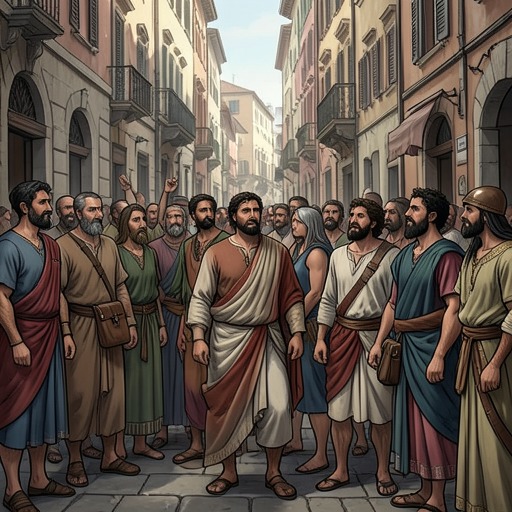
The crowd includes people from Africa, northern Europe, Britain, Gaul, Germany, the Euphrates, the Indus, Syria, Arabia, Egypt, and many Greek-speaking regions. Greeks are described as sharing command of the city with Romans through learning, art, wisdom, and guile. Alongside visitors and traders are enslaved people, freedmen, idle residents supported and entertained by Caesar, and newcomers drawn by the prospect of fortune. Priests of Serapis, Isis, Cybele, and other deities move among dancers, amulet sellers, snake-tamers, and seers. The Forum’s religious life is therefore as diverse as its commercial and linguistic life; Greek is heard as often as Latin.
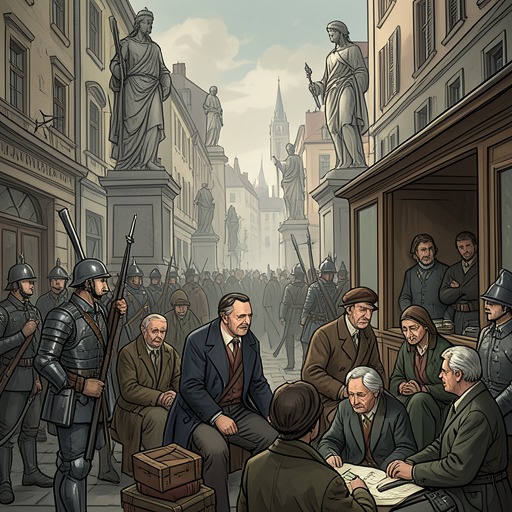
The same public space also displays hierarchy and dependence. Senators and knights pass in litters, their names repeated by the crowd with praise or mockery, while soldiers and street-watchers move through the less ordered groups to maintain order. Beyond the central spectacle are people who seek weekly grain from storehouses on the Tiber, compete for lottery tickets to the Circus, and spend their days beneath porticoes or near the houses of the wealthy, hoping for scraps from enslaved household workers. The Forum gathers Rome’s many populations together, but does not erase the differences in status or security that separate them.
The Fire and the Breakdown of Urban Order
When news of Rome’s burning reaches Vinicius, he races toward the city. By the time he approaches its walls, the roads and surrounding sites are filled with displaced people. Houses, fields, gardens, cemeteries, and temples have become makeshift camps; people break into the Temple of Mars near the Porta Appia for shelter, and fights erupt over refuge in cemetery monuments. The Forum belongs to a city whose ordinary distinctions of law, family, and rank are giving way under the pressure of catastrophe.
The fire disrupts movement as well as shelter. Vinicius finds the Appian Gate difficult to reach through the crowds, and the heat prevents him from passing through it into the city. The bridge at the Porta Trigenia has not yet been built, so reaching the Trans-Tiber requires a detour to the Pons Sublicius around the Aventine, through an area already engulfed in fire. He instead plans to turn back toward Ustrinum, cross the river below the city, and reach the Via Portuensis. A familiar centurion gives him a small body of soldiers, which Vinicius commands as he forces a path through the crowd. His urgency brings him into conflict with the people trying to flee or find safety, while nearby voices accuse Nero of setting the city alight. The episode makes clear that the Forum’s civic world depends on routes, bridges, gates, and public order that the disaster has made impassable or unreliable.
The fire itself spreads through densely occupied districts containing multistory houses, shops, wooden structures, and storehouses. New outbreaks in distant places lead observers to suspect that human hands are extending the destruction, but suspicion and rumor remain distinct from established proof. As residents flee through the gates, people from surrounding towns and countryside enter the city, some drawn by the prospect of plunder. The Forum’s cosmopolitan crowd thus has a darker counterpart in the disorder beyond its ordinary marketplaces: the same diversity that marks the city’s life becomes part of a mass movement in which fear, loss, and opportunity collide.
Food, Relief, and the Politics of the Crowd
The loss of Rome’s immense stores of provisions brings hunger into the crisis. Hundreds of thousands of displaced people are left outside the walls, and the need for supplies becomes urgent before proper arrangements can be made. When Tigellinus orders food sent from Ostia, the first delivery of bread reaches the Emporium, where the crowd seizes the provisions and fighting breaks out. Flour spills across the ground near the granary and the arches of Drusus and Germanicus; soldiers eventually take control of the building and disperse the crowd. Food supply is not an abstraction in this account: it depends on transport, storage, access, and the authorities’ ability to prevent a distribution point from becoming a flashpoint.
The emergency becomes a political confrontation when Petronius rides, unarmed apart from his customary ivory cane, into a hostile crowd. The people recognize him as Arbiter Elegantiarum, and his reputation for humane conduct—strengthened by his opposition to the collective execution of Pedanius Secundus’s slaves—helps change the crowd’s response. Petronius promises that Rome will be rebuilt, that public gardens will be opened, and that wheat, wine, and olives will be distributed the next day. He also promises games and gifts. The crowd answers with a demand for bread and circuses, and he asks them to acclaim Caesar before dispersing for the night. The scene links material relief to political spectacle: promises of food and entertainment soothe immediate anger while also serving the ruler’s need for public support.
Relief later arrives on a larger scale. Camps occupy imperial and aristocratic gardens, the Campus Martius, porticoes, and other open spaces. Provisions come by river from Ostia in such quantity that boats and barges nearly bridge the Tiber; wheat is sold at a very low price and given free to the poor, while wine, olives, chestnuts, sheep, and cattle enter the city. The danger of famine is averted, but the temporary camps do not restore ordinary order. Theft, murder, abductions, and nightly clashes continue, and bodies left along the Tiber contribute to sickness in the heat. The Forum’s earlier flow of shoppers and passersby has given way to a city where access to food and safety remains inseparable from crowd control and political authority.
Narrative Significance
The Roman Forum serves as a measure of Rome’s condition before and after disaster. In its first appearance, the crowded columns, markets, temples, and languages convey the reach and vitality of an imperial capital. Yet the scene also places public abundance beside dependence: grain recipients, freedmen, enslaved people, and the urban poor are present within the same city that displays costly goods and elite processions.
After the Great Fire, that tension becomes a crisis of governance. The Forum’s surrounding routes and public spaces register the failure of ordinary infrastructure, while the Emporium’s food deliveries and Petronius’s address show how provisioning and public speech can redirect a crowd’s anger. The promises of wheat and spectacle answer real needs, but they also expose a political order trying to secure consent amid ruin. The Forum is therefore more than a setting: it is the point where Rome’s imperial scale, social divisions, urban vulnerability, and dependence on the mood of its people become visible together.